 Verisutras
Building a Decision Checklist That Actually Gets Used
Most professionals already know the general shape of a good decision: gather relevant information, weigh the trade-offs, choose, and review the outcome later.
The general shape of a good decision is familiar to most professionals. The problem is rarely the theory. It is that this process lives entirely in someone’s head. Its quality depends on how tired, rushed, or distracted that person happens to be on a given day.
A checklist is one of the simplest tools available to close that gap. Judgment stays the decision-maker’s job. The checklist just guards the conditions under which judgment usually breaks down: time pressure, incomplete information, and the quiet pull toward whatever choice requires the least effort right now.
Problem
Most checklists fail for a predictable reason: they try to cover every possible scenario, which makes them long. Length is what kills adoption. A checklist that takes fifteen minutes to complete will be skipped the first time someone is busy. Once a checklist gets skipped, it stops getting opened at all.
The second common failure is treating a checklist as documentation rather than as a tool. A checklist buried in a shared drive, opened once during onboarding and never again, has no effect on behavior. It only works if it is faster to use than to ignore.
Analysis
Two properties determine whether a checklist survives contact with a busy week: brevity and placement.
Brevity means five to nine items, not twenty. Research on working memory going back to George Miller’s classic 1956 paper on short-term recall consistently points to a similar range for how much a person can reliably hold and act on at once. A checklist that exceeds this range asks for more discipline than most people have available under normal conditions, and discipline is exactly what the tool is meant to replace.
Placement means the checklist has to appear inside the moment the decision is actually made, not as a separate step someone has to remember to go find. A checklist for hiring decisions belongs inside the interview scorecard, not in a separate policy document. A checklist for vendor selection belongs inside the procurement form, not in an email sent out once a quarter.
Evidence
The clearest public demonstration of this idea comes from aviation and surgery, two fields where the cost of a missed step is unusually visible. Dr. Atul Gawande’s The Checklist Manifesto documents a World Health Organization surgical safety checklist, tested across eight hospitals internationally. It reduced major complications by roughly a third and deaths by nearly half.
The checklist itself was short: about nineteen items, most of them things any experienced surgeon already knew. Its effect came from forcing those items to be said out loud, at a fixed point in the procedure, every time.
The lesson holds outside medicine too: a checklist’s value comes from guaranteeing that something people already know gets applied consistently, at the exact moment it matters, regardless of how the day is going.
Method
A checklist built for actual use, rather than for looking thorough, tends to follow four rules.
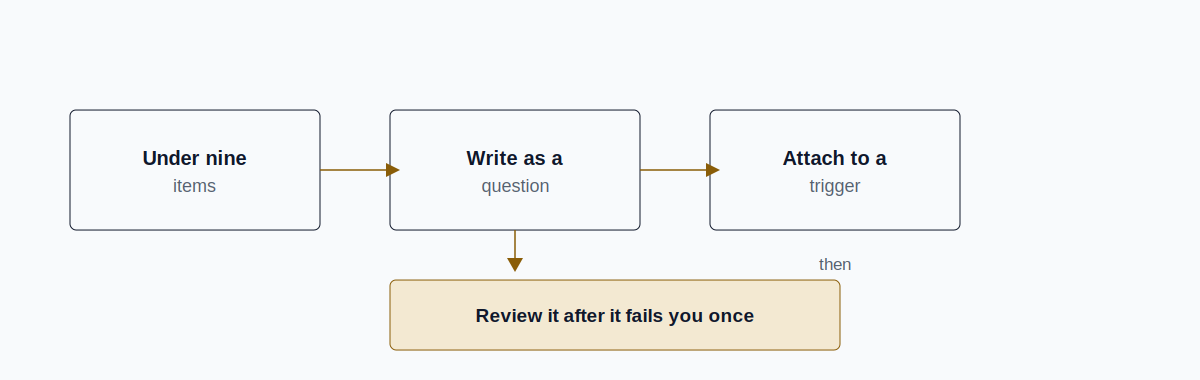
Four rules that separate a checklist people use from one they skip.
Keep it under nine items
If a list grows past that, split it into two checklists for two distinct moments, rather than one long list for a single moment.
Write it as a question, not a statement
“Have all stakeholders been notified?” prompts a check. “Notify stakeholders” is easy to skim past without registering.
Attach it to a trigger, not a calendar
A checklist tied to “before every client proposal goes out” gets used far more reliably than one tied to “review quarterly.”
Review it after it fails you once
The first time a checklist misses something important, that is the signal to revise it, not to abandon it. A checklist works best as something you revisit and adjust, not a document you write once and forget.
Examples
A hiring checklist that survives real use might contain five questions:
- Does the scorecard match the role’s actual requirements?
- Has every interviewer submitted independent notes before the debrief?
- Have at least two people separately flagged any concerns?
- Is the compensation band confirmed before the offer conversation?
- Has a reference check been completed for the finalist?
A vendor-selection checklist might ask:
- Has pricing been compared across at least two alternatives?
- Is there a documented exit clause?
- Has a security or compliance review been completed where relevant?
- Does the contract term match the actual planning horizon?
- Has someone outside procurement reviewed the total cost, not just the headline price?
Neither list teaches anything new to an experienced professional. Both exist to make sure nothing gets skipped on a day when there are four other things competing for attention.
Recommendations
Start with one recurring decision that has gone wrong before, not a hypothetical one. Write down what was actually missed the last time it went wrong, and build the checklist backward from that specific failure. Keep the list to a single page, ideally to a single screen. Place it inside the tool where the decision already happens, rather than asking people to open a second document. Revisit it only when it fails, not on a fixed schedule that treats it as paperwork.
Key takeaways
- A checklist earns its value through consistency.
- Short, situated checklists outperform long, comprehensive ones because they actually get used.
- Consistency, not comprehensiveness, is what makes a checklist reliable.
- The goal is to protect judgment from the ordinary conditions that wear it down over a normal week.
References
1. Miller, G. A. (1956). The magical number seven, plus or minus two: Some limits on our capacity for processing information. Psychological Review.
2. Haynes, A. B., Weiser, T. G., Berry, W. R., et al. (2009). A surgical safety checklist to reduce morbidity and mortality in a global population. New England Journal of Medicine.
3. Dr. Atul Gawande (2009). The Checklist Manifesto: How to Get Things Right.