 Verisutras
Typing Speed and the Quality of Your Thinking
Typing speed usually gets filed under clerical skills, not thinking skills. Writing researchers see it differently.
Every act of writing splits into two jobs happening at once: composing the idea, and transcribing it into text. Those two jobs compete for the same limited mental bandwidth.
Problem
When typing itself takes effort, hunting for keys, correcting mistakes, thinking about finger placement, that effort has to come from somewhere. It comes out of the same mental budget used for composing the idea in the first place.
Slow, effortful typing does not just slow down output. It taxes the thinking happening behind it too.
Analysis
Writing researchers call this the transcription-composition trade-off. Keyboarding fluency is treated as a subskill of transcription, and transcription competes directly with composition for working memory.
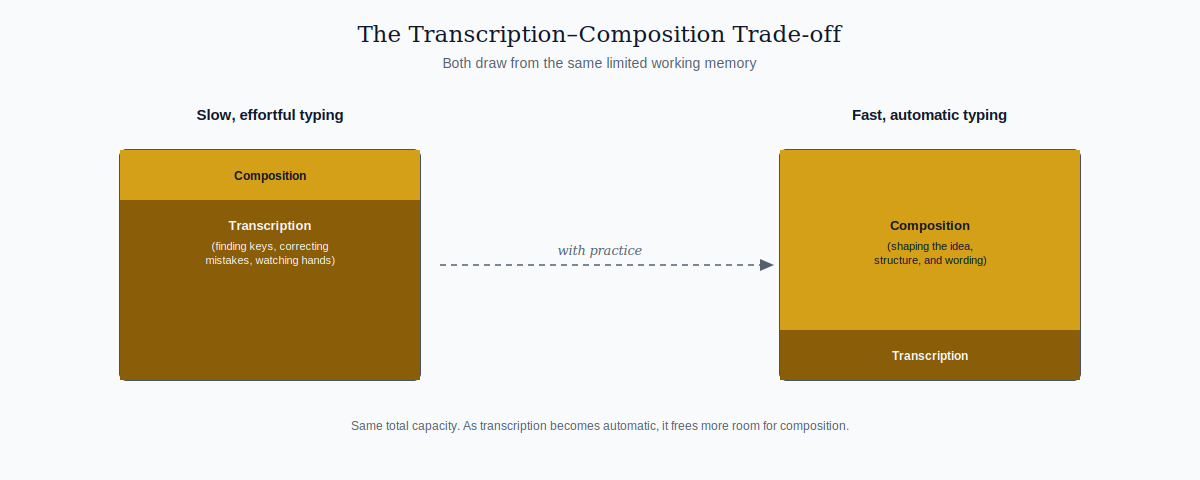
Same total mental capacity either way. The less room transcription takes up, the more is left for actually shaping the idea.
When transcription is fast and automatic, that competition mostly disappears, freeing attention for the harder work of shaping the idea itself. When transcription is slow or effortful, the opposite happens: composition quality drops, not because the thinking got harder, but because there was less mental capacity left for it.
Evidence
Across multiple studies, transcription fluency shows a measurable relationship with writing quality, averaging around 0.41 in one meta-analysis, and with writing productivity, around 0.53 in another.
Separately, a 2016 study on typing method found that people who type with two hands but never learned formal touch typing reach only 50 to 80 percent of a trained touch typist’s speed, with more errors along the way. Most self-taught typists plateau around 40 to 50 words per minute. That ceiling is a technique problem, not a talent problem.
Method
Four changes account for most of the gap between an average typist and a fast, accurate one.
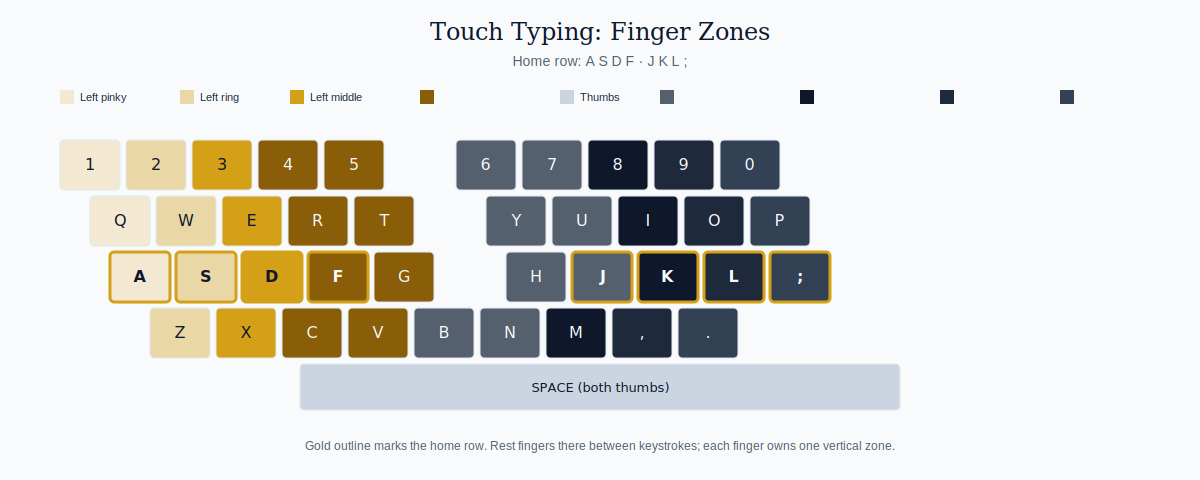
Each color marks the keys one finger is responsible for. The gold outline marks the home row.
Anchor on the home row
Left fingers rest on A, S, D, F. Right fingers rest on J, K, L, and the semicolon. Every other key is one small reach away from that resting position.
Stop looking at the keyboard
This feels slower for the first week and is the single biggest lever after that. Looking down breaks the muscle memory that makes touch typing fast in the first place.
Train accuracy before speed
A typist at 80 WPM with frequent mistakes is often slower in practice than one at 65 WPM with few, because correcting errors costs more time than it appears to.
Ignore layout debates
Alternative layouts like Dvorak offer only a marginal advantage for most people. Technique accounts for far more of the gap than the layout underneath it.
Examples
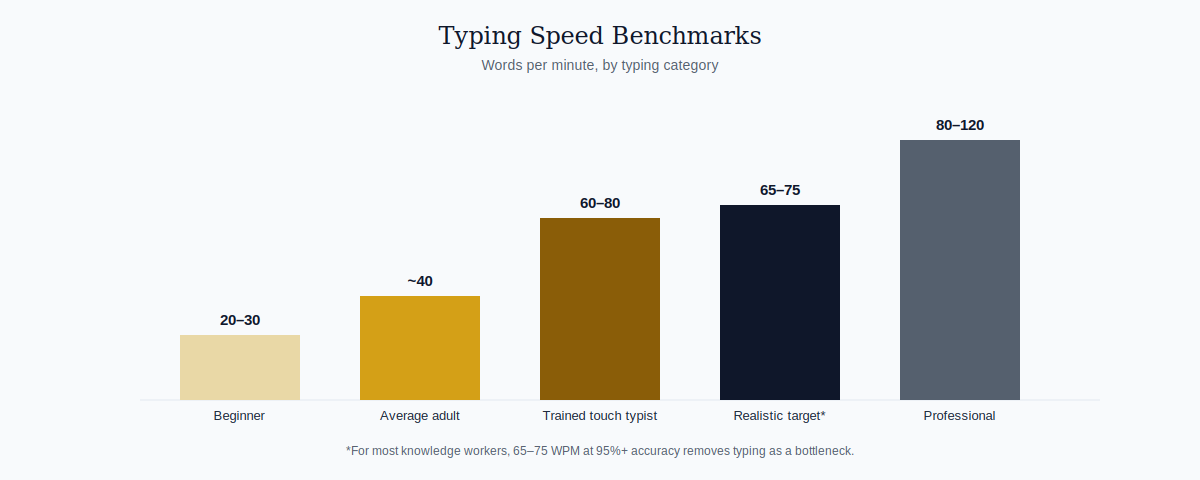
For most knowledge workers, 65 to 75 WPM at 95%+ accuracy removes typing as a bottleneck.
Recommendations
If writing or thinking on a keyboard is a daily part of the job, a few weeks of deliberate touch-typing practice is a disproportionately high-return investment.
Start with home row placement, cover the hands if needed to break the habit of looking down, and drill short sessions daily rather than occasional long ones. Track accuracy alongside speed from the start.
Key takeaways
- Typing fluency is a thinking skill, not just a clerical one.
- Transcription and composition compete for the same mental capacity.
- Touch typing technique, not keyboard layout, is what actually closes the speed gap.
- A realistic target for most professionals is 65 to 75 WPM at high accuracy, not elite speed.
References
1. Association of keyboarding fluency and writing performance in online-delivered assessment. ScienceDirect.
2. Promoting Handwriting Fluency for Preschool and Elementary-Age Students: Meta-Analysis. PMC.
3. The process-disruption hypothesis: how spelling and typing skill affects written composition. PMC.
4. Feit, A. M., et al. (2016). Typing speeds of self-taught vs. touch typists. ACM UIST.
5. Average Typing Speed 2026: WPM by Age, Job & Country. TypingTestPro.